
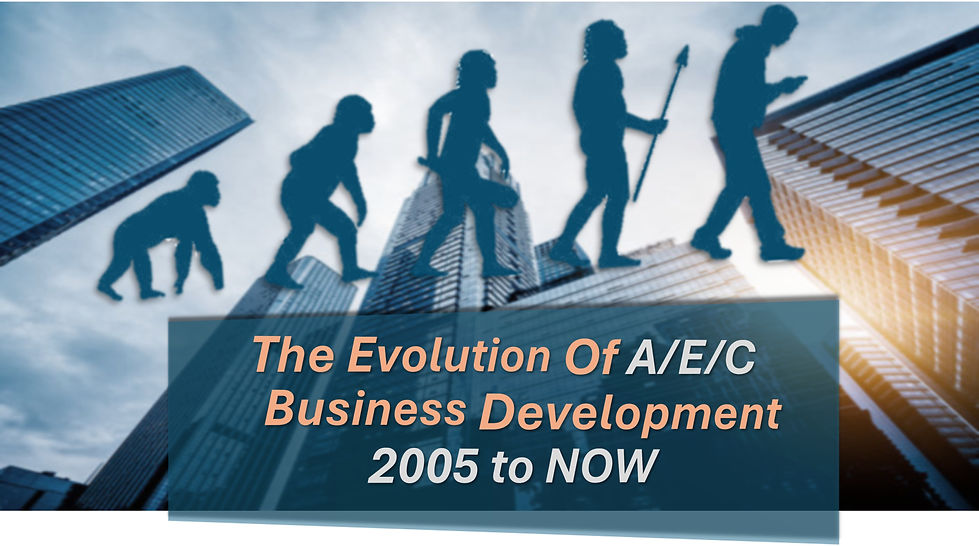
The Evolution of A/E/C
Business Development (2005–2025)
Over the past 20 years, business development (BD) in architecture, engineering, and construction (A/E/C) has transformed from relationship-driven “rainmaking” to a structured, data-informed, and technology-enabled discipline.
Firms now integrate marketing, capture planning, and client experience management to compete in a rapidly changing marketplace.
2005–2010: From Boom to Bust
-
2005 was benchmarked by record high construction spending across A/E/C markets, with record employment and staff utilization rates.
-
The American subprime mortgage crisis was a multinational financial crisis that occurred between 2007 and 2010, contributing to the 2008 financial crash. Trillions of dollars in design and construction projects dried up - almost overnight. A/E/C firms reduced overhead staff starting with deep cuts in marketing departments and non-billable BD people.
-
Firm principals and project leaders were thrust into business development including calling on current and prospective clients. This was The End Users first taste of engaging early and directly with firm leaders, and not BD people. And they liked it. A lot!
-
The 2008 financial crash accelerated the emergence and widespread usage of the seller doer model and set the direction for how A/E/C firms would do BD for the next 20 years.
2010–2015: From Rainmaking to Repeatable Process
-
BD begins formalizing beyond “who you know.” Firms start adopting CRMs and pursuit pipelines; Deltek’s long-running Clarity study becomes a common benchmarking source for hit rates, pipeline health, and proposal volume.
-
Design-build and alternative delivery (IPD) gain momentum, nudging BD toward earlier capture planning and teaming.
2016–2019: Digital + Content + Key Accounts
-
Thought leadership, SEO, and especially LinkedIn become core to pre-positioning; marketing and BD functions integrate more tightly around account-based campaigns and client experience (CX) programs highlighted by SMPS research. (SMPS)
-
Market strength raises competition: proposal management matures (gate reviews, color teams), and firms codify seller-doer expectations with more training and KPIs (hit/win rates, cost of pursuit), as reflected in Clarity benchmarks. (Deltek)
2020–2021: Pandemic Shock → Virtual BD
-
Overnight shift to virtual selling—webinars, digital shortlist interviews, and remote teaming—accelerates tech stack adoption (CRM, marketing automation, analytics) and tightens pursuit discipline. Industry trackers (PSMJ/FMI) documented the proposal pipeline’s swings and the move to proactive positioning in resilient public infrastructure.
2022–2025: Data-driven Capture, Teaming, and AI Enter The Stack
-
BD becomes increasingly metrics-led: firms benchmark pipeline, hit rates, and capture steps; Deltek’s 45th/46th Clarity studies emphasize planning rigor, PM enablement, and the first waves of AI for research and proposal support.
-
Design-build surges toward ~50% market share by 2028, making early owner engagement, partner selection, and JV strategy central BD skills.
-
Market mix shifts: softness in private markets vs. strength in public/non-building (power, transportation, water) pushes BD to target funded programs (IIJA/IRA-adjacent), expand geographic reach, and prioritize strategic pursuits over volume. PSMJ and FMI track proposal activity and end-market dynamics guiding BD focus.
-
Teams are stretched; SMPS’s 2024 trends call for better tools, automation, and CX to sustain BD outputs with lean staff.
What This Means For Firms Now
-
Pre-position earlier. Owners and partners are chosen well before RFP—BD must lead capture planning, influence delivery method, and assemble teams early (especially for design-build).
-
Run a real pipeline. Treat pursuits like a portfolio: stage gates, probability weighting, and pursuit ROI; benchmark against peer data each year.
-
Align Account Based Marketing (ABM) with BD to reduce sales cycles by 25% and increase win rates by 8 percentage points.
-
Blend seller-doers with dedicated capture. Train technical leaders for relationship growth while supporting them with proposal ops, research, and marketing automation.
-
Aim BD at resilient segments. Tilt prospecting toward non-building infrastructure and programmatic funding where activity is strongest.
-
Use AI—practically. Apply it to market intel, partner screening, boilerplate first drafts, and interview prep, while keeping human QC for strategy and differentiation (a trend flagged in recent Clarity findings).
Bottom Line
AEC business development has evolved from relationship-driven "rainmakers" to structured, data-informed, and integrated and aligned, marketing/BD teams, supporting BD efforts of principals/project leaders in revenue strategy.
Firms that adapt to early positioning, seller-doer clarity, and capture discipline outperform those still operating reactively.
The Solutions
With 30 years’ experience leading A/E/C business development with firms including Haskell, CRB, IMEG, and BSA, I’ve successfully navigated multiple market ups and downs from 2006 market crash to 2021 COVID19, and in that time, I’ve learned what works, and what doesn’t.
Fusion BD helps A/E/C firms engage more End-Users and win work by implementing customized, data driven, strategies.
We don’t just give advice. We put my 30 years as an A/E/C business developer to work for you to:
Deliver customized, data-driven strategies
Implement proven plans and processes
Increase end user engagement
Reduce “non-billable” BD cost
To learn more, let's connect. I'd welcome a brief 30 minute call with you and/or your team to answer any questions and determine if the Marketing/BD Hybrid Model is right for your firm.
Jump on my calender:
https://calendly.com/steven-fusionbdllc/30min
Email me directly:
View Frequently Asked Questions:
Next Steps
