

The 2nd Annual
FusionBD
AEC Buyers Survey
2026
NEW !
Understanding How Purchasers of A/E/C Services Prefer to Engage in Business Development — and How They Now Research, Discover, and Evaluate Firms Online
Author: Steven S. McGill, Principal / Founder, Fusion BD®
© 2026 by Fusion BD® | All Rights Reserved

Executive Summary
For the second year, this research study delivers critical insights into buyer preferences for engaging with architecture, engineering, and construction (A/E/C) firms. Based on responses from 109 decision-makers across healthcare systems, advanced manufacturing, pharmaceutical manufacturing, and higher education sectors, the survey reveals a decisive preference for engagement with Principals and Project Leaders over traditional business development staff.
New for 2026, this edition adds a Marketing section examining how these same buyers now research, discover, and evaluate A/E/C firms through search engines, artificial intelligence, LinkedIn, and firm websites. The findings confirm a fundamental truth: a large share of the buyer’s journey now happens before a firm ever knows it is being considered.
Key Findings - Business Development
-
92% of buyers prefer reaching out to Principals/Project Leaders with RFPs/RFQs, versus only 5% for BD personnel
-
90% of buyers either “sometimes” or “always” exclude BD persons from formal project interviews
-
81% of buyers receive 7–15+ meeting requests per week from BD staff, creating significant meeting fatigue
-
Buyers are 49% more likely to respond to cold-call meeting requests from Principals/Project Leaders than from BD staff
-
69% of buyers remain loyal to Principals/Project Leaders who change firms, versus only 30% for BD staff
(c)FusionBD2026
(c)FusionBD2026
(c)FusionBD2026
(c)FusionBD2026
(c)FusionBD2026
(c)FusionBD2026

New for 2026!

Key Findings - Marketing, Search & AI
-
66% of buyers use search engines to research A/E/C service providers 6 or more times per week — meaning your firm may be under consideration without your knowledge
-
36% of buyers now use AI tools such as ChatGPT and Claude to build initial shortlists of providers with a specific scope of expertise — forming shortlists long before an RFP is issued
-
61% of buyers use LinkedIn for industry knowledge, peer connection, and provider research
-
96% of buyers are “never” or “not likely” to respond positively to a LinkedIn InMail cold-call meeting request from a BD person — outbound selling on the platform may actively backfire
-
27% of buyers “sometimes” use a website “Request Information” form to initiate contact — an inbound channel trending upward and concentrated among Gen X and Millennial buyers
(c)FusionBD2026
(c)FusionBD2026
(c)FusionBD2026
(c)FusionBD2026
(c)FusionBD2026
(c)FusionBD2026
Together, these findings extend recent industry research from SMPS and others — which found that 89% of A/E/C firms now use the seller-doer model, up 15% since 2015 — and align with other 2025–2026 B2B research showing that the majority of the buying journey is completed
before a buyer ever contacts your firm - or not.
(c)FusionBD2026
Starting With "The Why"
Background and Context
Some very good research has been conducted on the seller-doer model by trade organizations serving architects, engineers, and construction professionals. The industry has clearly recognized the shift from nontechnical business development personnel leading sales efforts to design and construction
principals and project leaders taking increasingly prominent roles.
However, a critical gap exists in previous research: those surveys polled A/E/C firm staff — Directors of Business Development, Marketing Directors, and firm Principals — rather than the buyers themselves. This survey addresses that gap by going directly to the buyers of A/E/C services. The VP's of Facilities, Director of Plant Operations, COO's, and others decision makers.
(c)FusionBD2026
Industry Context
Recent SMPS Foundation research (AEC.BD: Building Business Development Success in a Post-Pandemic World, 2024) confirms this trend:
-
89% of A/E/C firms now utilize seller-doers, up from 74% in 2015
-
47% of firms are actively adding business development staff
-
47% of firms are simultaneously adding seller-doer positions
-
70% of firms use the seller-doer model specifically because of client preferences
-
60% report it has become cultural: “we’ve always done it that way”
(c)FusionBD2026
(c)FusionBD2026
(c)FusionBD2026
(c)FusionBD2026
The Critical Challenge
What the old research doesn't address is our findings that 67% of A/E/C firms report they are still struggling to define roles and responsibilities for both Principals/Project Leaders and business development staff.
Firms express uncertainty about where in the sales cycle:
-
A “Billable” Principal/Project Leader is most effective
-
A “Non-Billable” business development person is best utilized.
(c)FusionBD2026
(c)FusionBD2026
(c)FusionBD2026
(c)FusionBD2026
(c)FusionBD2026
A New Dimension for 2026:
"The Digital Front Door"
There is a second gap that this year’s survey addresses. While the industry has focused on who should engage the buyer, far less attention has been paid to how the buyer finds the firm in the first place.
Buyers increasingly begin their evaluation privately — through search engines, AI assistants, LinkedIn, and firm websites — assembling shortlists before any human contact occurs. Understanding that behavior is now as strategically important as understanding the buyers meeting and interview preferences.


(c)FusionBD2026
(c)FusionBD2026

Why This Research Matters
(c)FusionBD2026
It is more important than ever to develop research data directly from the clients themselves — the Vice Presidents of Facilities, Directors of Plant Operations, Chief Operating Officers, and other decision-makers who actually purchase A/E/C services.
Understanding client preferences from the source enables firms to:
-
Optimize resource allocation between BD staff and technical professionals
-
Reduce wasted meeting requests that create client fatigue
-
Increase win rates by aligning engagement strategies with client expectations
-
Improve ROI on business development and marketing investments
-
Ensure the firm is discoverable and credible during the private, pre-contact research phase
The Objective
(c)FusionBD2026
To assess how end-users respond to outreach from Business Development (BD) personnel versus Principals/Project Leaders within the A/E/C industry — and, new for 2026, how clients/buyers research, discover, and evaluate A/E/C firms through digital channels — in order to provide actionable insight into buyer preferences across the entire modern engagement journey.
This research aims to answer:
-
When do clients prefer to engage with BD professionals versus technical staff?
-
What are the optimal touchpoints for each role in the sales cycle?
-
How do client preferences vary by engagement type (cold outreach, existing relationships, RFP/RFQ, interviews)?
-
Where and how do buyers discover and evaluate firms before making contact?
-
What factors drive client loyalty, responsiveness, and shortlist inclusion?
(c)FusionBD2026
The Respondents
With more than three decades of experience as an AEC buisness developer with firms including, Haskell, IMEG, CRB, & BSA, I wanted to give the buyers that I know the opportunity to voice their buying preferences.
For this survey, I leveraged long-standing relationships with Vice Presidents of Facilities, Directors of Plant Operations, Chief Operating Officers, and other purchasers of A/E/C services to deliver actionable insight into how buyers actually want to engage — not how our industry assumes they do.
(c)FusionBD2026
Decision Making Authority
-
Vice Presidents of Facilities
-
Directors of Facilities
-
Plant Operations Managers
-
Chief Operating Officers
-
Other executives responsible for contracting A/E/C services
(c)FusionBD2026
Project Scale
-
Average project range: $1 million to more than $500 million (construction value)
(c)FusionBD2026
Market Sectors
-
Healthcare Systems
-
Advanced Manufacturing
-
Pharmaceutical Manufacturing
-
Higher Education
(c)FusionBD2026
Response Metrics
-
392 survey requests sent to end-users
-
109 respondents completed the survey (30.2% response rate)
-
28 respondents provided additional detailed comments
(c)FusionBD2026
Significance
The strong response rate and detailed commentary indicate that buyers genuinely appreciated the opportunity to voice their preferences regarding A/E/C business development and marketing practices.
(c)FusionBD2026
Part One — Business Development Engagement Results
The survey was formatted to enable respondents to provide critical feedback regarding their engagement preferences with BD staff versus Principals/Project Leaders across various business development scenarios.
(c)FusionBD2026
Cold Calling
Question #1a: Likelihood of responding to a cold-call meeting request from a BD person at an A/E/C firm unknown to you
-
Never: 47%
-
Not Likely: 36%
-
Sometimes: 17%
-
Always: 0%
Question #1b: Likelihood of responding to a cold-call meeting request from a Principal/Project Leader at an A/E/C firm unknown to you
-
Always: 0%
-
Sometimes: 32%
-
Not Likely: 36%
-
Never: 32%

(c)FusionBD2026
(c)FusionBD2026
(c)FusionBD2026
Analysis
Buyers showed 32% “Sometimes” responsiveness for Principals/Project Leaders versus only 17% for BD staff — a 49% higher response rate for technical professionals. Respondents cited daily internal pressures, deadlines, and staffing constraints as making time for unknown firms difficult; even so, they were markedly more willing to grant time to a Principal/Project Leader.
(c)FusionBD2026
(c)FusionBD2026
Client Commentary Themes
-
“Too many BD calls, not enough time to evaluate new firms unless there’s an immediate need.”
-
“I want to talk to someone who understands our technical challenges, not just a salesperson.”
-
“Cold calls from BD people feel like interruptions; calls from project leaders feel like potential solutions.”
Name Recognition
Question #2a: Likelihood of responding to a cold call from a BD person at an A/E/C firm you’ve heard of
-
Never: 39%
-
Not Likely: 31%
-
Sometimes: 30%
-
Always: 0%
Question #2b: Likelihood of responding to a cold call from a Principal/Project Leader at an A/E/C firm you’ve heard of
-
Never: 21%
-
Not Likely: 18%
-
Sometimes: 61%
-
Always: 0%

(c)FusionBD2026
(c)FusionBD2026
(c)FusionBD2026
(c)FusionBD2026
Analysis
Buyers are significantly more likely to respond to a Principal/Project Leader (61% “sometimes”) than a BD person (30%) even when the firm has name recognition. Clients prefer to meet when they have a specific need, or actively considering a change of provider, or face a technical challenge requiring expert consultation.
Key Insight
Name recognition helps, but it does not override the preference for engaging with technical professionals (two times more than BD) who can speak substantively about project solutions.
(c)FusionBD2026
Meeting Request Volume from BD Persons
Question #3: How often are you approached by an A/E/C BD person for meeting requests per week?
-
0–3 requests: 0%
-
4–6 requests: 19%
-
7–14 requests: 54%
-
15+ requests: 27%
Total receiving 7+ requests per week: 81%
(c)FusionBD2026

(c)FusionBD2026
Analysis
The volume of BD meeting requests has reached critical mass. 81% of end-users receive 7–15 or more requests each week — a level of outreach respondents describe as overwhelming and counterproductive. Several indicated the sheer volume causes them to ignore BD people altogether, and two respondents explicitly stated they refuse to ever meet with BD people due to meeting-request fatigue.
(c)FusionBD2026
Client Commentary Themes
-
"I've started automatically declining meetings with anyone who has ‘Business Development’ in their title. I simply don’t have time for exploratory conversations with people who can’t answer my technical questions."
What If They Move to a New Firm?
Question #4a: Likelihood of responding to a known BD person now at a different firm
-
Never: 39%
-
Not Likely: 44%
-
Sometimes: 15%
-
Always: 2%
(c)FusionBD2026
Question #4b: Likelihood of responding to a known Principal/Project Leader now at a different firm
-
Never: 14%
-
Not Likely: 17%
-
Sometimes: 61%
-
Always: 8%
(c)FusionBD2026

(c)FusionBD2026
Analysis
69% of buyers will “Always” or “Sometimes” respond to a Principal/Project Leader they have worked with previously, even after that professional changes firms — versus only 17% for a BD person from a prior firm. Buyers indicated that the relationships built through solving actual project challenges creates far stronger loyalty than the facilitation/transactional relationship provided by BD staff.
(c)FusionBD2026
Strategic Implications
-
Place greater emphasis on retaining technical professionals with strong client relationships
-
BD professionals moving to new firms can't be counted on to immediately transfer client relationships
-
Compensation and retention packages should reflect the different relationship values
-
Succession planning must account for the relationship equity held by technical professionals
Current Clients
Question #5a: Likelihood of responding to a known BD person from a firm you’re currently working with
-
Never: 15%
-
Not Likely: 31%
-
Sometimes: 51%
-
Always: 3%
(c)FusionBD2026
Question #5b: Likelihood of responding to a known Principal/Project Leader from a firm you’re currently working with
-
Never: 0%
-
Not Likely: 13%
-
Sometimes: 38%
-
Always: 49%
(c)FusionBD2026

(c)FusionBD2026
Analysis
49% of buyers would “Always” respond to Principals/Project Leaders when they have current projects in process, versus only 3% for BD persons. Even with an active project relationship, owners remain reluctant to spend time with BD people.
Client Commentary Themes
"I prefer meeting with the technical professionals associated with current work because they can answer substantive questions about projects and operations."
"The Principal knows our operation, our constraints, our goals—the BD person is just trying to schedule a meeting"
Industry Alignment: This validates SMPS research showing approximately 80% of an A/E/C firm’s business comes through existing or past clients, underscoring the critical importance of seller-doers in driving revenue.
(c)FusionBD2026
(c)FusionBD2026
Meeting Requests Per Week from Principals/Project Leaders
Question #6: How often are you approached by an A/E/C Principal/Project Leader for meeting requests per week?
-
0–3 requests: 56%
-
4–6 requests: 44%
-
7–14 requests: 0%
-
15+ requests: 0%
(c)FusionBD2026

(c)FusionBD2026
Analysis
Principals/Project Leaders request far fewer meetings than BD people — 100% receive 0–6 requests per week, compared to 81% of BD requests arriving at 7–15+ per week. Yet Clients are roughly twice as likely to accept a meeting from a Principal/Project Leader. The lesson is clear: quality of outreach far outweighs quantity of outreach.
(c)FusionBD2026
RFP/RFQ Preference
Question #7a: Likelihood of reaching out to a firm’s BD person with a new opportunity (RFP/RFQ)
-
Never: 22%
-
Not Likely: 53%
-
Sometimes: 20%
-
Always: 5%
Question #7b: Likelihood of reaching out to a firm’s Principal/Project Leader with a new opportunity (RFP/RFQ)
-
Never: 0%
-
Not Likely: 0%
-
Sometimes: 8%
-
Always: 92%

(c)FusionBD2026
(c)FusionBD2026
(c)FusionBD2026
Analysis
This is the most decisive finding in the entire survey: 92% of end-users will “Always” reach out to a Principal/Project Leader with an RFP/RFQ, while only 5% will contact a BD person. Buyers want to start the conversation directly with the people who will actually know how to solve their problem.
Client Commentary Themes
-
"Why would I send an RFP to a salesperson when I need to talk to the engineers and architects who will actually solve my problem? The BD person just forwards it internally anyway — I’d rather start the conversation with the people who understand my project."
(c)FusionBD2026
Relationship Building
Question #8a: Likelihood of forming ongoing relationships (dinners, events, golf) with a BD person
-
Never: 28%
-
Not Likely: 59%
-
Sometimes: 9%
-
Always: 4%
(c)FusionBD2026
Question #8b: Likelihood of forming ongoing relationships (dinners, events, golf) with a Principal/Project Leader
-
Never: 12%
-
Not Likely: 33%
-
Sometimes: 32%
-
Always: 23%
(c)FusionBD2026

Analysis
Respondents favor relationship-building with Principals/Project Leaders over BD persons at roughly three times the rate (55% “Sometimes”/“Always” vs. 13%). Buyers view time with technical leaders as a strategic investment — access to firm leadership, direct communication channels, and genuine partnership — while time with BD staff is viewed as social obligation without strategic value.
(c)FusionBD2026
Project Interview Preference
Question #9: How often do you exclude BD people from formal project interviews?
-
Never: 10%
-
Sometimes: 64%
-
Always: 26%
(c)FusionBD2026
Total “Sometimes” or “Always” excluding BD: 90%

(c)FusionBD2026
Analysis
90% of end-users either “Sometimes” or “Always” prohibit BD people from participating in formal project interviews. Buyers want to ask technical questions, assess team chemistry, and evaluate the professionals who will actually manage their project — not listen to a sales presentation.

New for 2026!
Part Two — Marketing, Search & AI: How Buyers Discover and Evaluate Firms
(c)FusionBD2026
For the 2026 edition, the survey added five questions examining how buyers use search engines, artificial intelligence, social media, and firm websites to research A/E/C service providers. Where Part One describes how buyers prefer to engage, Part Two describes how buyers now discover — a phase that increasingly plays out privately, before a firm has any idea it is being considered.
A consistent theme runs through the broader B2B research that frames this section: the majority of the buying journey is now completed before a buyer contacts a vendor. Forrester’s 2025 survey of more than 4,000 professional services buyers found that roughly 61% of the buying journey is complete before the buyer contacts a vendor, and multiple 2025–2026 studies place buyers at 70% or more of the way through evaluation before engaging sales. For A/E/C firms, this means the
"Digital Front Door” is now doing much of the selling.
(c)FusionBD2026
Search Engines
Question #M1: How often do you use search engines (Google, Bing, and others) to look up A/E/C service providers?
-
0–5 times per week: 34%
-
6–10 times per week: 29%
-
11 or more times per week: 37%
(c)FusionBD2026

(c)FusionBD2026
Analysis
This is no surprise to most of us — but the magnitude matters. Two-thirds of respondents (66%) research providers online six or more times per week, which means your firm may be under active consideration without your knowledge. This supports what most AEC marketing departments have long asserted: search-engine visibility is a baseline requirement, not a differentiator, and more must be done to remain competitive.
(c)FusionBD2026
Client Feeback
Clients report using search engines whenever they look for alternative service providers, and specifically before deciding whether to meet with a firm for the first time. In other words, search is not just a discovery tool — it is a screening tool used to decide who is worth a conversation.
Industry Context & Supporting Research
The survey’s finding is consistent with broader B2B and AEC-specific research from 2025–2026:
-
A January 2026 survey found that 57% of U.S. B2B decision-makers still start early research with traditional search engines — more than any other channel — making SEO (and increasingly generative-engine optimization) table stakes for early-funnel visibility.
-
AEC-focused analyses consistently report that buyers complete roughly 70% of their journey independently, visiting firm websites, studying project portfolios, and checking credentials before ever reaching out - or accepting a meeting invitation.
-
Because nearly three-quarters of searchers never move past the first page of results, ranking position directly affects whether a firm makes the initial consideration set.
(c)FusionBD2026
(c)FusionBD2026
Implications
For A/E/C firms, the practical takeaway is that shortlist inclusion now depends on discoverability. A thin or dated digital footprint quietly removes a firm from consideration; a technically credible, well-structured, portfolio-driven web presence keeps it in the running. SEO should be treated as ongoing infrastructure — owned, measured, and resourced — rather than a one-time website project.
(c)FusionBD2026
Artificial Intelligence
Question #M2: In the last year, how often have you used AI (ChatGPT, Claude, and others) to create an initial list of providers with expertise in an exact scope of work you need performed?
-
0–5 times per month: 64%
-
6–10 times per month: 36%
-
11 or more times per month: 0%
(c)FusionBD2026

(c)FusionBD2026
Analysis
This confirms what our industry has been hearing anecdotally. Instead of a file cabinet full of provider brochures and collateral — as was once the case — 36% of A/E/C services buyers now use AI at least six times a month to research and assemble shortlists of A/E/C service providers with expertise in the specific scope of work they need performed. That the “11 or more” bucket registered 0% suggests AI is currently a targeted shortlisting tool, not yet an everyday habit — but adoption is clearly underway.
(c)FusionBD2026
Client Feedback
Clients note that AI is becoming increasingly prevalent across many aspects of their jobs, and that finding a broader pool of specialists is one way to reduce risk. By identifying subject-matter experts who have done the exact work before, buyers avoid taking chances on providers who would be “learning on their project.”
Industry Context & Supporting Research
The buyer commentary is strongly corroborated by 2025–2026 research:
-
Forrester’s 2026 Buyers’ Journey Survey of nearly 18,000 global business buyers found that 94% used AI during their most recent purchase process — up from 89% the prior year — with buyers using AI to compare service providers, research capabilities, and build internal business cases before any vendor contact.
-
Independent analyses report that AI answer engines have become a leading vendor-research source, and that buyers increasingly form a “Day One shortlist” on their own, with the pre-contact favorite winning a large majority of deals.
-
Notably, the signals that drive AI visibility differ from those that drive traditional rankings: research indicates the strongest predictor of appearing in AI answers is how frequently a brand is cited across authoritative sources — earned mentions, not just on-page keywords.
(c)FusionBD2026
Implications
Buyers are finding A/E/C service providers and building shortlists for RFPs long before your firm ever knows the projects exist.
This reframes thought leadership and earned media as direct pipeline activities. To be recommended by an AI assistant, a firm needs a consistent, credible, specific body of published expertise — case studies, technical articles, conference presence, and third-party citations — tied to the precise scopes of work it wants to win.
Generic capability statements do not surface; documented, specific expertise does. This is the emerging discipline some now call generative-engine or answer-engine optimization, and it belongs on the marketing roadmap alongside traditional SEO.
(c)FusionBD2026
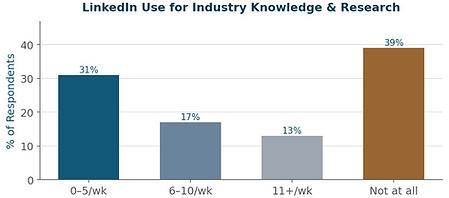
LinkedIn as an Industry Resource
Question #M3: How often do you use LinkedIn for industry knowledge, connecting with peers, and connecting with service providers?
-
0–5 times per week: 31%
-
6–10 times per week: 17%
-
11 or more times per week: 13%
-
Not at all: 39%
(c)FusionBD2026
(c)FusionBD2026
Analysis
61% of clients use LinkedIn for industry connection — whether for links to trade organizations, peer groups, industry knowledge, or provider research. Given that the platform’s algorithms continue to surface information relevant to each buyer, maintaining both a corporate and a professional presence on LinkedIn is essential for A/E/C service providers. It is worth noting, however, that 39% report not using it at all — so LinkedIn should be treated as an important channel within a mix, not a universal one.
(c)FusionBD2026
Client Feedback
-
Most feedback described LinkedIn as their go-to source for current events within their industry.
-
Some said they used it for provider research.
-
Two indicated they had used it to fill positions within their departments.
Industry Context & Supporting Research
-
AEC marketing analyses consistently rank LinkedIn as the top channel for thought leadership, professional networking, and reaching commercial decision-makers.
-
Millennials — who now make up the majority of B2B buyers and a large and growing share of final decision-makers — lean heavily on digital and social channels, and more than half of younger buyers report relying on social media and personal networks when making purchasing decisions.
(c)FusionBD2026
Implications
LinkedIn’s value for A/E/C firms is as a presence and credibility channel, not a direct-outbound channel (a distinction reinforced sharply by the next question).
Consistent, substantive content — published by Principals and technical leaders, not only the corporate account — is what earns algorithmic reach and positions the firm as a knowledgeable peer in the feeds buyers already scroll.
LinkedIn Cold Outreach (InMail)
Question #M4: How likely are you to respond positively to a LinkedIn InMail cold-call meeting invite from a BD person at an A/E/C provider?
-
Never: 74%
-
Not Likely: 22%
-
Sometimes: 4%
-
Always: 0%
(c)FusionBD2026

(c)FusionBD2026
Analysis
This is one of the starkest findings in the entire survey. 96% of buyers are “Never” or “Not Likely” to respond positively to a BD cold InMail, and not a single respondent chose “Always.” The same buyers who value LinkedIn as an industry resource actively reject it as a sales-prospecting channel.
(c)FusionBD2026
Client Feedback
-
Several clients indicated LinkedIn is a more personal platform, and they are put off by salespeople contacting them there for meetings.
-
Many said they receive so many InMail messages that they ignore them completely.
Industry Context & Supporting Research
-
Across B2B generally, cold-outreach response rates have declined sharply — average cold-email reply rates have fallen to roughly 3–5%, and senior buyers increasingly guard their inboxes against generic outreach.
-
Gartner research finds that a majority of B2B buyers now prefer a “rep-free” buying experience, and that roughly three-quarters actively avoid vendors who send irrelevant outreach — meaning poorly targeted prospecting does not just fail, it can damage the brand.
-
General LinkedIn benchmarks report InMail response rates in the 10–25% range for well-targeted, personalized outreach — but our A/E/C buyers’ near-total rejection suggests this audience is considerably less receptive to platform prospecting than the cross-industry average.
(c)FusionBD2026
Implications
It may actually be detrimental for an A/E/C BD person to attempt to contact a buyer through LinkedIn InMail.
Combined with Question M3, the guidance is clear: use LinkedIn to publish and to be found, not to cold-pitch. The platform rewards visibility and credibility,
and penalizes interruption.
For firms that have invested in LinkedIn prospecting quotas for BD staff, this finding warrants a candid re-examination of whether that activity is helping or quietly eroding reputation with the exact buyers they hope to reach.
(c)FusionBD2026
(c)FusionBD2026
Website “Request Information” / Inbound Contact
Question #M5: How often have you used a provider’s website “Request Information / Contact” form to request a conversation about a design or construction need?
-
Never: 47%
-
Not Likely: 26%
-
Sometimes: 27%
-
Always: 0%
(c)FusionBD2026

(c)FusionBD2026
Analysis
This channel is beginning to trend. Although “Sometimes” is only about one-quarter of buyers, the direction is meaningful. During my recent time with a large engineering/construction firm, I personally watched this play out: within the first six months a “Request Information” capability was instituted, unsolicited inquiries from quality leads went from near zero to — by the end of that year — roughly three to six genuine inquiries per month. Small numbers, but high-intent ones.
Client Feedback
Of the buyers who selected “Sometimes,” none were Baby Boomers — most were either Gen X or Millennials. The behavior is concentrated among younger decision-makers, which points to where the trend is heading.
(c)FusionBD2026
Industry Context & Supporting Research
-
Millennials now make up the majority of B2B buyers and a large share of final decision-makers, and this cohort strongly prefers self-directed, digital-first buying — with a substantial share preferring a rep-free experience for at least part of the journey.
-
Forrester has projected that more than half of large B2B transactions ($1M+) will move through digital self-serve channels — including vendor websites — as generational buying power shifts, signaling that inbound website contact will grow in strategic importance.
Implications
As younger men and women gain positions of authority in A/E/C buying decisions, the inbound website inquiry is likely to demand
more attention in the near future.
The strategic risk is not generating these leads — it is fumbling them. A high-intent inquiry that sits unanswered for days sends exactly the wrong signal. Firms will need internal systems and clear ownership for handling inbound inquiries quickly, so that responsiveness itself becomes a demonstration of how the firm treats clients.
(c)FusionBD2026
New Insights: What the Data Reveals
Taken together, the two parts of this survey describe a single, coherent shift. Across the entire client-facing portion of the sales cycle, Principals/Project Leaders outperform BD staff — and across the entire pre-contact portion of the journey, buyers now discover and screen firms digitally, on their own terms, often before a firm even knows a project exists.
Engagement (Part One)
-
RFP/RFQ: 92% prefer Principals/Project Leaders; only 5% prefer BD persons.
-
Project interviews: 90% “sometimes” or “always” exclude BD staff.
-
Relationship building: 55% favor Principals/Project Leaders vs. only 13% for BD staff.
-
Meeting volume: 81% receive 7–15+ BD requests weekly, yet respond roughly twice as often to the far fewer Principal/Project Leader requests.
-
Loyalty on firm change: 69% stay responsive to Principals/Project Leaders vs. 30% for BD staff.
(c)FusionBD2026
(c)FusionBD2026
(c)FusionBD2026
(c)FusionBD2026
(c)FusionBD2026
(c)FusionBD2026
Discovery (Part Two)
-
Search: 66% research providers online 6+ times per week — firms are screened before contact.
-
AI: 36% use AI monthly to build scope-specific shortlists — before RFPs exist.
-
LinkedIn presence: 61% use it for industry knowledge and research.
-
LinkedIn prospecting: 96% reject BD cold InMail — outbound selling backfires.
-
Website inbound: 27% “sometimes” initiate contact via website forms — concentrated among Gen X and Millennial buyers.
(c)FusionBD2026
(c)FusionBD2026
(c)FusionBD2026
(c)FusionBD2026
(c)FusionBD2026
(c)FusionBD2026
The Through-Line
The buyer’s journey now has two distinct halves. In the private half, buyers use search, AI, LinkedIn, and firm websites to decide who is even worth a conversation — which makes marketing, thought leadership, and digital credibility the price of admission to the shortlist.
This is the domain of the marketing team.
In the client facing engaged half, buyers overwhelmingly want to deal with technical Principals and Project Leaders, not BD staff. The firms that win will be discoverable and credible in the first half, and technically led in the second.
This is the domain of technical leadership.
(c)FusionBD2026
The Implications: Realigning Roles, Responsibilities - and the "Digital Front Door"
The actionable insight from this survey is that A/E/C firms must respond to buyer preferences on two fronts at once: realigning who engages the buyer, and strengthening how the firm is discovered before that engagement ever begins.
Client-Facing Activities: Led by Principals/Project Leaders
The following client-facing efforts should be led by Principals/Project Leaders:
-
Client meetings (existing and prospective)
-
Relationship-building activities
-
RFP/RFQ management and response
-
Project interviews and presentations
-
Closing sales and negotiating contracts
-
Strategic planning discussions with key clients
(c)FusionBD2026
Business Development / Marketing Staff: Setting Principals Up for Success
The primary responsibility of BD/Marketing staff is to set Principals/Project Leaders up for success — focusing less on client-facing selling and more on the strategic functions below. The 2026 marketing findings expand this mandate: Full integration of BD/Marketing staff. The combined team is now also responsible for the firm’s discoverability and credibility during the private, pre-contact research phase.
-
Research and Intelligence — market analysis, competitive intelligence, client research, pipeline tracking
-
Prospecting and Qualification — target identification, opportunity qualification, CRM management, lead scoring
-
Opening Doors — introductions, network leverage, event coordination, creating opportunities for technical professionals to demonstrate expertise
-
Digital Discoverability — SEO and generative-engine/answer-engine optimization, so the firm surfaces in both search and AI-generated shortlists for its target scopes of work
-
Content and Thought Leadership — specific, credible published expertise (case studies, technical articles, conference presence, earned media) that both persuades buyers and earns AI citations
-
LinkedIn Presence — equipping Principals and technical leaders to publish and be found, rather than deploying BD staff to cold-prospect (which the data shows backfires)
-
Inbound Response Systems — fast, owned processes for handling website “Request Information” inquiries, so high-intent leads are met with responsiveness
-
Proposal and Presentation Support — RFP/RFQ coordination, proposal writing, graphics, compliance and review
-
Training and Enablement — coaching seller-doers, sharing market insights, building tools and templates, driving CRM adoption
(c)FusionBD2026
(c)FusionBD2026
How Do Principals/Project Leaders Balance BD and Billable Work?
To set Principals and Project Managers up for success, firms must:
-
Recognize BD as billable-equivalent work — adjust utilization targets, provide clear time-allocation guidance (e.g., ~20% for BD), and credit BD activity in performance metrics
-
Prioritize relationship-based BD — focus seller-doer effort on existing relationships where ROI is highest and leverage current projects as platforms for additional opportunities
-
Provide robust BD support infrastructure — enable delegation of research, prospecting, and administrative tasks, and offer proposal and presentation support
-
Implement training and development — close the 67% training gap with coaching and mentoring
-
Create incentive alignment — establish clear BD metrics, tie compensation to results, and recognize successful efforts
(c)FusionBD2026
(c)FusionBD2026
(c)FusionBD2026
How AEC Firms Are Changing To Meet The New Realities Of BD/Marketing.
As firms grapple with optimizing their approach — and as the marketing findings raise the bar for digital discoverability some emerging models are gaining traction.
Account Based Marketing (ABM)
(c)FusionBD2026

ABM flips traditional marketing on its head. Instead of casting a wide net to capture leads, you treat high-value target accounts as individual markets, focusing all your resources on personalized engagement.
Think of it this way:
Traditional marketing: Fishing with a net—catch many fish, sort later.
ABM: Spearfishing—identify the exact fish you want and go after it.
How ABM Works in Practice
-
Align Business Development and Marketing
-
Identify Your Ideal Accounts
-
Build Deep Intelligence
-
Create Personalized Campaigns
-
Engage Across Multiple Channels
Real Results: What the Data Shows
-
25% reduction in sales cycles. From 120 to 90 days on average.
-
8-point increase in win rates. From 18% to 26% in documented cases.
-
80% of marketers report ABM increases customer lifetime value.
-
Higher ROI than traditional demand generation approaches.
(c)FusionBD2026
(c)FusionBD2026
(c)FusionBD2026
BD / Marketing Hybrid
(c)FusionBD2026

Because traditional BD staff are increasingly excluded from the activities that actually win work, they can only coordinate but cannot close.
The Hybrid Model acknowledges this reality and optimized for it – placing lower cost support staff in coordination roles while empowering higher-value technical leaders in client-facing position.
It eliminates silos between marketing and BD, provides broader skill sets and flexibility, enables better integration of strategy with execution, reduces overhead versus separate teams, and creates professionals who understand both.
What A BD/Marketing Hybrid Does
Multi-functional BD/Marketing team member who focuses on strategic support rather than client-facing engagements. Key responsibilities include:
-
Strategic Planning & Research
-
Marketing Content & Campaigns
-
Pursuit Support
-
Principal Support & Coordination
Not A passing Trend
Firms adopting this model are reporting higher win rates, lower BD cost, and better alignment between their BD pracitces and client experience improvement.
(c)FusionBD2026
(c)FusionBD2026
(c)FusionBD2026
Conclusions and Recommendations
Key Takeaways
(c)FusionBD2026
Over the last several years, A/E/C firms have worked to adjust the roles that BD persons and Principals/Project Leaders play in business development. The data from this survey brings clarity to just how essential technical engagement is to end-users — and, new for 2026, to how decisively the discovery phase has moved into private, digital, AI-assisted channels that operate before a firm knows it is being considered.
The Path Forward
(c)FusionBD2026
To succeed in today’s market, A/E/C firms must blend the efforts of marketing, BD, and Principals/Project Leaders to meet the preferences of their end-user/target client — across both the private discovery phase and the engaged selling phase.
-
Honest Assessment — evaluate current BD effectiveness and client satisfaction, and audit how the firm actually appears in search results and AI-generated shortlists for its target scopes of work
-
Strategic Realignment — shift client-facing activity to Principals/Project Leaders; reposition BD/Marketing as enablers; reduce high-volume, low-value outreach; invest in quality over quantity
-
Digital Infrastructure — build genuine SEO/AI discoverability, a portfolio-driven and credible website, LinkedIn presence led by technical professionals, and fast inbound-response systems
(c)FusionBD2026
-
Content and Thought Leadership — publish specific, documented expertise that both persuades human buyers and earns the third-party citations that drive AI visibility
-
Training and Development — close the 67% seller-doer training gap; provide ongoing coaching; build incentive systems that drive the right behaviors
-
Cultural Transformation — elevate seller-doer contributions, treat relationship-building and thought leadership as strategic work, and measure success by quality of relationships and shortlist inclusion, not volume of activity
(c)FusionBD2026
Final Thoughts
These findings should not be read as suggesting that BD professionals lack value or should be eliminated. Rather, the data reveals that BD/Marketing staff and Principals/Project Leaders serve different, complementary functions — and that the modern buyer journey now begins in a digital front door - before it ever reaches the client facing meeting the firm has traditionally focused on.
Success requires:
-
Right person, right role, right time
-
Discoverable and credible before contact; technically led after it
-
Quality engagement over volume of activity
-
Technical credibility in every client-facing situation
-
Strategic marketing and BD support enabling seller-doer success
Firms that align their approach with client preferences - on both fronts - will gain significant competitive advantage in an increasingly sophisticated marketplace where clients research privately, shortlist independently, and demand technical expertise from the very first conversation.
(c)FusionBD2026
Appendix: Research Methodology
Survey Design
The 2026 survey consisted of two sections. The nine core business-development questions assess engagement preferences across multiple scenarios, each posed in parallel format (once for BD personnel and once for Principals/Project Leaders) to enable direct comparison:
-
Cold calling (unknown firms)
-
Name recognition (known firms)
-
Meeting-request volume
-
Relationship portability (firm transitions)
-
Current-client engagement
-
RFP/RFQ contact preferences
-
Project-interview participation
-
Relationship building
-
Meeting-request frequency
New for 2026, five marketing questions assess how buyers research, discover, and evaluate firms through digital channels:
-
Search-engine usage
-
Artificial-intelligence usage for shortlisting
-
LinkedIn usage as an industry resource
-
LinkedIn InMail cold-outreach receptivity
-
Website “Request Information” / inbound contact usage
Response Scale
Most questions used a four-point Likert scale (Never, Not Likely, Sometimes, Always). Volume and frequency questions used ranges appropriate to the context.
Distribution and Response
-
Sample frame: 392 end-user decision-makers in healthcare systems, advanced manufacturing, pharmaceutical manufacturing, and higher education
-
Response rate: 30.2% (109 completed surveys)
-
Qualitative feedback: 28 respondents provided detailed commentary
-
Timing: Survey conducted mid-year 2026
Data Analysis
Results were analyzed for preference patterns across BD personnel vs. Principals/Project Leaders; volume and impact of meeting requests; relationship loyalty and portability; digital discovery and evaluation behavior; and variations by engagement type. Qualitative comments were reviewed to identify common themes and provide context for the quantitative findings.
A Note on Supporting Sources
The marketing section is contextualized with third-party B2B and A/E/C research published in 2025–2026, including buyer-journey and AI-adoption studies from Forrester and Gartner, AEC-specific marketing analyses, and generational B2B buying research. These sources corroborate and extend the survey’s primary findings; they do not replace them. The primary data throughout this report reflects the responses of the 109 end-user decision-makers surveyed by Fusion BD.
Copyright and Usage
Fusion BD® PUBLICATIONS
Fusion BD LLC | www.fusionbdllc.com | © 2026 Fusion BD®
Author: Steven McGill, Principal, Fusion BD®
All rights reserved. No part of this research report may be reprinted, reproduced, or utilized in any form or by any electronic, mechanical, or other means, now known or hereafter invented, including photocopying and recording, or in any information storage or retrieval system, without permission in writing from Fusion BD®.
(c)FusionBD2026
(c)FusionBD2026
(c)FusionBD2026
(c)FusionBD2026
(c)FusionBD2026
I timed the release of this survey for leadership teams planning season, while AEC firms are setting BD and marketing strategy, budgets, and goals for 2027.
What I've found most useful for firms is walking through the results together — not just the data, but what it means for how firms
structure their BD and marketing effort next year.
I'm scheduling those sessions now.
If your ready to plan for 2027, I welcome the opportunity to meet with you and your team.
Email me directly with days/times that work best for you.
Respectfully,
Steven
